
Best Friends, animal testing progress, elephant kills, lion hunts, meat and more.
The Animal Media Week That Was 12-21-2025

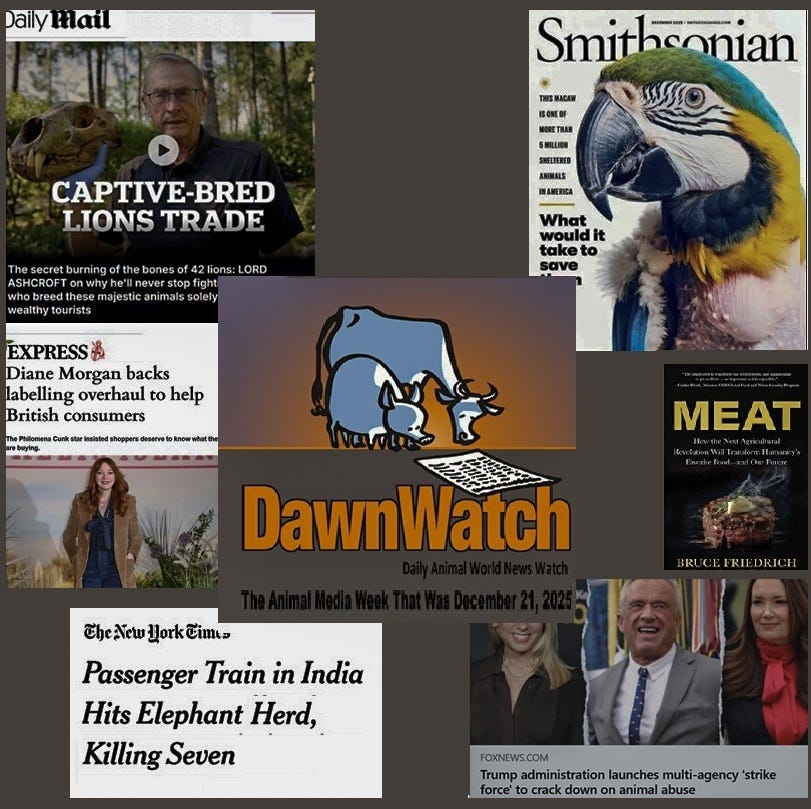
Once again, there is so much going on with animals in the major mainstream media, it’s hard to keep up. Given that when I started monitoring the media 25 years ago, I had to search high and low for an animal story, what a welcome problem!
Elephants, so beloved by humans, were in the news over the weekend, with the New York Times reporting, “Passenger Train in India Hits Elephant Herd, Killing Seven. No people were injured in the accident, despite a partial derailment. As elephant habitat shrinks, such deadly encounters are on the rise.” Here’s a gift link to that one, shared with thanks to Teresa D’Amico. Thanks also to Elaine Livesey-Fassel for letting us know that the story was in the Sunday, December 21, Los Angeles Times on page A3 under the heading, “Passenger train kills 7 wild elephants crossing tracks in India.”
Along with natural sorrow, I responded to that one with some relief that the deaths were an accident, given what generally happens to elephants out of the public eye, which brings us to:
The South China Morning Post, which often covers animal issues seriously, included an article titled, “Elephants deployed in flood recovery spur debate” which tells us, “When the Indonesian island of Sumatra was struggling to recover from devastating floods last week, local authorities in Aceh turned to an unconventional form of help to clear debris: elephants... The move to deploy four trained elephants in Pidie Jaya regency, however, has drawn mixed reactions, with some experts praising the effective response to extreme conditions and others criticising it due to the risks faced by the critically endangered species.”
Those relatively new to animal rights issues may not know that the reason it is never ethical to use elephants for human purposes is that an animal so much more powerful than humans cannot be “tamed” by them without having been terrorized, with that process being known as phajaan. I am distressed to say that I just attempted to share a video of that torture only to find it has been removed for violating YouTube violence laws. We are free while travelling to ride on elephants who have suffered it, but YouTube won’t let us look at it!
I did find this video about Lek’s beautiful work, which seems to tell the story.
HUNTING
I share a little more awfulness, which at least has some superb coverage this week, before we get to better stuff: The Mail, from the UK, last Sunday, ran a piece by Lord Ashcroft, titled, “The secret burning of the bones of 42 lions. And why I’ll never stop fighting the monsters who breed them solely to be shot by wealthy tourists.”
Meanwhile the Washington Post brings us a story about Pennsylvania politics that lets us know that the one thing all sides seem to agree on is the pleasure of killing bears. Here’s a gift link to that sorrowful hunting fluff piece.
RODEO
At least the awfulness that is rodeo got some strong coverage in the San Diego Union Tribune this week, with the paper running an op-ed titled, “Cruel San Diego Rodeo returns to Petco Park for third year,” featuring a revolting calf-roping photo and telling us of the past two years:
“On the opening night of the inaugural rodeo, a horse named Waco Kid panicked, bolted and slammed full-speed into a metal fence. He has not been heard from since.
“Despite efforts to prohibit the most violent rodeo activities, the second San Diego Rodeo went ahead. This time, a mare who was nearly 11 months pregnant collapsed minutes after her forced ‘performance.’ She died, along with her unborn foal.”
I urge San Diego folks, and others who feel strongly about the abuse of animals for human entertainment to weigh in with letters appreciative of the piece and against the rodeo with letters sent to letters@sduniontribune.com, which must include your full name, community of residence and a daytime phone number, and must be less than 150 words long.
ANIMAL TESTING
The true progress finally being made against animal testing has been beautifully covered over the last week, with the conservative paper, the Washington Times, announcing, “Congress orders Defense Department to stop painful experiments on dogs and cats” with that article quoting Rep. Don Davis, a North Carolina Democrat who backed the changes while noting the coalition of left and right championing the cause. (Thanks to Lew Regenstein for sending that our way.)
The Associated Press shares, “US military to stop shooting pigs and goats as a way to train medics in the battlefield,” with numerous papers including the Washington Post and ABC having run that article, which tells us, “The prohibition on ‘live fire’ training that includes animals is part of this year’s annual defense bill, although other uses of animals for wartime training will continue. The ban was championed by Rep. Vern Buchanan, a Florida Republican who often focuses on animal rights issues.”
BEST FRIENDS
On that note, Lara Trump hosted a wonderful segment on Fox News in which she interviewed Attorney General Pam Bondi and Secretaries Brooke Rollins and RFK Jr. The segment’s promotional blurb notes that those guests “say they are cracking down on animal cruelty, rolling out coordinated actions across the Justice Department, the Department of Agriculture (USDA) and the Department of Health and Human Services (HHS) to target dogfighting, puppy mills and animal testing.”
It is well worth listening to, with Rollins and Bondi talking powerfully about puppy mills and dogfighting, and RFK Jr noting that government agencies are committed to “ending animal testing.” I am pleased to note that he does not single out dogs and cats alone. He criticized the inertia of those who say they are interested in ending animal testing but are not moving forward quickly, and he noted that the “badge for a humane nation is the way it takes care of its animals.”
Sadly, at the end of the segment, Trump and Rollins praised “good breeders” as opposed to puppy mills, while the next article I share makes it clear that this country’s kill stats reveal the importance of the #AdoptdontShop mantra. Anybody following Lara Trump, however, can see that her commitment to animals is real. I have little doubt that when she learns more about the continuing pet overpopulation crisis, she will be unlikely to continue to support “responsible breeders” while hundreds of thousands of loving animals are killed for lack of homes.
That brings us to the December 2025 issue of Smithsonian Magazine’s beautiful cover story essay, replete with gorgeous photos, on the Best Friends Animal Sanctuary in Utah. Online it is titled, “The Nation’s Biggest Animal Sanctuary Operates Under a Mantra to ‘Save Them All.’ How Could That Be Controversial? Best Friends Animal Society has a sprawling campus in the canyons of Utah, but its influence has grown to reach almost every shelter in the country.”
Those of you who read my Substack piece about Winky Smalls’ meeting with Jane Goodall know that I have cause for a strong pro Best Friends bias as Winky was at the Best Friends No Kill Los Angeles (NKLA) shelter for eight months before he came to me. If they hadn’t rescued him, and been willing to hold him indefinitely, in the best shelter conditions possible, I would not have the greatest blessing of my life. I therefore recommend this article wholeheartedly, while appreciating that it mentions pushback against Best Friends, since that is part of the organization’s story. Some of that pushback comes from my friend Ed Boks, whose work you may have been introduced to when you subscribed to this Substack as we recommend each other’s work. I think it’s worth being familiar with the criticisms, though my take, for now, is that I can’t fault activists who reach for the stars and don’t quite get there, but who rescue angels like Winky Smalls while making the effort.
REHOMING ORCAS
Speaking of making valiant huge efforts and facing doubt and criticism: The Observer has a dispiriting and I think unfair headline, “Free Willy lifeline is just a fantasy for France’s last two captive orcas” over an article that shares the difficulties faced by the Whale Sanctuary Project in rehoming them but does not leave me with the impression that getting them to sanctuary is only a fantasy.
MEAT
Current Affairs, a magazine with a dedication to including animal rights issues that is profoundly noteworthy, has run an interview with John Sanbonmatsu, the author of The Omnivore’s Deception, which is worth reading. I share it because Sanbonmatsu makes important points, worth exploring, though I am not a huge fan of his activism style, which may focus more on being right than on a style of advocacy likely to save animals. (If you have no idea what I mean by that, I wholeheartedly recommend the Landmark Forum, an inexpensive life-changing program undertaken by many of our movement’s most effective leaders, and the classic book Influence: The Psychology of Persuasion, which I wish every animal advocate would read.)
I am especially wary of sharing his work knowing he rails against the cultivated meat industry. 25 years of full time work in the animal rights movement has led me to believe that only a small percentage of humans will go and stay vegan because it’s the right thing to do, so our best hope, by far, of saving billions of animals from horror every year is creating real meat that does not rely on mass animal farming and slaughter. We are not quite there yet – just as the whale sanctuary isn’t quite there yet – but railing against it won’t get us there faster.
That brings me to Bruce Friedrich’s new book, Meat: How the Next Agricultural Revolution Will Transform Humanity’s Favorite Food – and Our Future, which has been selected by Publishers Weekly as one of the ten best new releases of 2026. Last week I shared a gift link to a Washington Post interview with Friedrich that had not yet appeared in print. I am pleased to note that the paper gave the interview prominent print coverage on Tuesday, December 16, page 2, and it is not too late to respond with a letter to the editor. (It was also in the Santa Fe New Mexican, Dec 12, page 26.)
Interestingly, that interview with Bruce Friedrich, who heads up the Good Food Institute, and who was with PETA for decades, then Farm Sanctuary, and continues to serve on the DawnWatch board, does not discuss animal suffering. Friedrich, just as committed to animals as Sanbonmatsu, takes the opposite activism approach, believing, perhaps ironically, that tack will attract more people to the cause. Those familiar with my work know that I believe the best approach lies somewhere in the middle, the Golden Mean, the Middle Way.
LABELLING LUNACY
Two articles in the UK press last week dealt with attempts by the meat industry and legislators beholden to them to obfuscate food labels:
The Guardian ran George Monbiot’s piece, “When is a sausage not really a sausage? Ask the meat lobby.” Monbiot writes: “Last week, the European Council and European Commission tried and failed to make sense of all this. They were unable to agree a common position with the European parliament, and bumped the decision to January, when a new council presidency will have to deal with it. I can’t blame them. You cannot make sense of a senseless policy.”
My favorite point in the piece: “If a vegetarian hotdog is to be ruled out, as the parliamentarians demand, on the grounds that it contains no meat, the meat version should be ruled out on the grounds that it contains no dog.” (Thanks to Mel Bromley for sending that our way.)
The Sunday Express covered the work of actress Diane Morgan, known for the Cunk mockumentaries, on Humane World for Animals’ push for more honest animal welfare labelling. Given that the DawnWatch mission is to encourage the media to cover animal issues well so that people can make informed choices in line with their own values, I was pleased to read this quote from her: “People care, they just don’t stand a chance when every message they get, every label, advert, website – is designed to make them feel fine about something that they might actually not be fine with at all.”
Finally, as I put together the DawnWatch end of year round-up of the major media animal stories for 2025, I was pleased to note that Vox, not an animal rights publication but one that consistently covers animal issues responsibly under its “Future Perfect” column, has put together “9 actually good things that happened to animals this year. It wasn’t all bad in 2025.”
Reporter Kenny Torrella describes the changes as incremental, but I see some of them as truly meaningful and indicative of societal shift, for example, “7) The US dairy industry tyranny weakened.” It is hard to believe that in 2025 “Schools are barred from proactively offering plant-based milk alternatives, like soy milk, even though most kids of color are lactose intolerant to some degree, and if a kid wants plant-based milk, they need a doctor’s note.” A bill having passed Congress to change that truly matters, with Torrella explaining, “It’s a win for student choice and food waste, but also for cows, who are subjected to a lot of terrible practices in the dairy industry.”
I love Torrella’s approach and admit to being tickled pink to learn he’d read my book Thanking the Monkey when it came out, hoping I may have made some small contribution to his extraordinary body of work for animals. I will end this weekly round-up with the ending of his column:
“However incremental most of these changes may be, they were hard fought for through intensive campaigning, coalition building, and public persuasion. They prove that these animal industries’ economic and political power doesn’t make them invincible, and that change for animals is possible through smart advocacy and new technologies. Here’s to hoping even more is accomplished in 2026.”
Yours, and all animals’,
Karen Dawn of DawnWatch
If you already subscribe and appreciate this post, please don’t forget to “like it” above. And your comments are invaluable.