
Breaking Points Gets Animal Rights Right
Glenn Greenwald's discussion of factory farming, the SOB Act, and the rescue of the Ridglan beagles from animal testing highlights the power of nonpartisan outreach

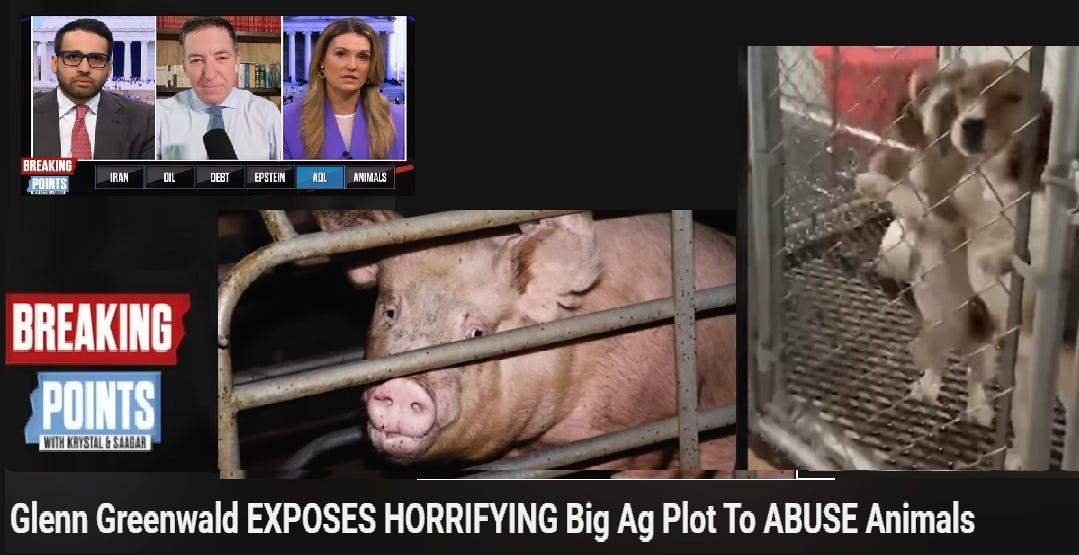
While DawnWatch is required by law to remain politically nonpartisan, I am personally nonpartisan by inclination and conviction. I therefore get much of my daily news from Breaking Points, a show with four regular hosts, two liberal and two conservative. They discuss and argue issues while showing mutual respect, a tone that seems rare these days.
Sadly, animal issues don’t come up often, which should be a wake-up call for animal advocates. Our Google news feed shows us exactly what it knows we want to see, which can give us the impression that everybody is talking about animals all the time. But outside of our circles, they usually are not.
At least when Breaking Points covers animals it does it well. On Thursday, May 8, they aired a superb segment as guest Glenn Greenwald discussed the disgraceful Save our Bacon Act, which is part of the Farm Bill making its way through Congress. The segment went on to cover the Ridglan Farms beagle rescues and then even touched on cultivated meat.
Glenn Greenwald, a renowned journalist with strong libertarian leanings, has been covering animal issues seriously and responsibly since at least the early 2000s when he objected to the disgraceful Animal Enterprise Terrorism Act. As I was putting together this piece, he released a video on Facebook about a dog rescue he and his late husband founded, which employs homeless humans to care for homeless dogs. And in his most recent Substack post, May 8, in which he answers audience questions, he discusses animal rights issues passionately beginning at 19:15.
For those new to Breaking Points, let me share that Thursday’s hosts were Krystal Ball, who is more passionately progressive than MSNBC, where she cut her teeth, and conservative Saagar Enjeti, who sometimes gets lovingly described by listeners as a thirty-year-old grandpa (he’s actually 34).
THE “SAVE OUR BACON” ACT – BETTER KNOWN AS SOB
Krystal’s introduction to the segment notes that California and other states have passed laws banning gestation crates that say, “Listen, what we do to these animals is horrific enough, at least we can require that they’re in a cage large enough where they can turn around.” She continues, describing the SOB Act: “This bill, that has already passed through the house and now heads to the senate says, no, we’re not going to allow states to carve out even this level of humanity towards these highly intelligent animals.”
During the interview Glenn refers to his 2017 piece for The Intercept, “The FBI’s Hunt for Two Missing Piglets Reveals the Federal Cover-Up of Barbaric Factory Farms: Systematic abuse of animals lies at the heart of U.S. industrial farms, which are protected by the government. Despite a crackdown on activists, the public is seeing the barbarism.” If you read it, you will understand why I am devoted to Greenwald for the way he handles animal issues, regardless of whether or not I agree with him on every other issue. Rather than wishing he focused solely on animals, I am grateful that his main focus is elsewhere. He attracts a large mainstream audience before whom he intermittently, seriously, and passionately discusses animal issues. Animals need more advocates who can do that!
During this segment, as we see photos and video of sows in gestation crates, Greenwald explains: “They go insane, they actually start biting through the metal cages, losing all their teeth….
Pigs are as intelligent as dogs, as sentient, and probably more emotionally complex, and what they are above all else is extremely social animals.”
Appealing to Breaking Points’ wide audience, he notes that the laws passed in some US States and in Europe are “not about being vegan”, but about saying “There is a level of sadism and cruelty that we won’t tolerate.”
Those interested in why I, an unabashedly vegan animal rights activist, champion a quest for common ground rather than pushing veganism, should check out my essay in The Progressive magazine, “Making Animal Protection a Political Issue.” It ran years ago but makes points about finding common ground that I wish were more widely accepted as self-evident in the animal advocacy world today.
I note in that essay that the greatest hope for real change for animals is for their rights to become a nonpartisan cause. I was therefore grateful that Greenwald, while discussing an anti-animal act introduced by a Republican, with mostly Republican support (though my most recent DawnWatch weekly round-up notes it also has passionate Republican detractors) also points out the following about California’s Prop 12, which banned the sale of pork from pigs who had no room to turn around in their cages:
“The Biden administration challenged it, tried to get the Supreme Court to overturn these animal laws in California and elsewhere.”
He continues discussing Prop 12: “The Supreme Court upheld it, and so now the industry is using their control over the Congress and the Senate, with their money, to basically ban what voters enacted saying ‘We don’t want, in our state, products that are a byproduct from the most sickening torture you can imagine.’“
Then we get to the part which I see as profoundly important for activists:
“It is all about corporate profits …. and unfortunately there’s no countervailing lobby that is for animal welfare. The interesting thing is that this has become genuinely bipartisan.
“I think dogs are kind of the gateway into understanding the cruelty to animals, and there have been now bipartisan efforts, and genuine bipartisan movements, to curb the worst of animal cruelty.”
Then referring to the SOB Act (noting points I have made about it having passionate detractors in the Senate) he adds, “It might run into problems in the Senate, but, you know, I’ve watched Congress long enough to know that you never place your bets against industry lobbyists-- they always seem to get their way.”
Let’s hope not, this time. Actually, let’s do more than hope. Take Action.
BEAGLES
Krystal takes the conversation onto the Ridglan Farms beagles with, “I also wanted to get your reaction to the rescue of 1500 beagles -- I mean these images, you know, getting to go outside and run around after being subjected to horrific conditions and being used for tests. Tell us about the way activists, at great cost to themselves, were able to secure the significant victory.”
Greenwald notes the horrors that beagles suffer in gratuitous experiments and then champions bipartisan animal advocacy again. He notes that Direct Action Everywhere - DxE (the organization that rescued the pigs who his Intercept article focused on) had been working to get Ridglan Farms closed, but that what finally led to the closure was bipartisan action. He tells us that the conservative anti-animal-testing group White Coat Waste was saying, “Hey you are conservative, you don’t want your government money funding hideous animal experimentation” while the left was told, “You love animals, you want to protect animals.”
He says that it “became this bipartisan movement because they weren’t picky or ideologically pure about who their allies would be, they just wanted to shut this facility and finally it’s getting shut. . . and . . . this kind of symbolizes how to do successful activism, both in this area and I think more broadly.”
Amen.
Greenwald adds a little more about the rescued dogs, noting many are killed when they are no longer useful experimental subjects, and we hear “Ugh” coming from both hosts, underlining his point about this being a bipartisan issue.
When I shared Ridglan Farms news in my most recent weekly round-up, I acknowledged mixed feelings about nonprofits paying Ridglan for the beagles. But as I discussed the issue with vegan hiker Josh Garrett in the comments section (and how I wish more of you would jump in with those comments) I came to see it differently. I think that the video of the beagles on grass for the first time, shared by venues less likely to share protest video and animal cruelty images, makes the money forfeited to Ridglan seem clearly well-spent given its impact against the animal testing industry. Seeing that video shared on ABC’s World News Tonight this week, and seeing Krystal’s reaction to it as cited above, backs that up.
Let me also note the groups negotiating the sale have been the Big Dog Ranch Rescue, which has strong Republican affiliation including having Lara Trump on the board, ensuring exposure of the issue to the right, and the Center for a Humane Economy, a nonpartisan advocacy group headed by Wayne Pacelle. Pacelle was one of my mentors in the field of nonpartisan animal advocacy. It seems to me that all the groups involved, hitting from all sides with differing tactics, have moved things in a truly positive direction.
WIDER SOB AND FACTORY FARMING ISSUES
Returning to the SOB Act, the hosts and Greenwald tie the support of factory farming to the wider betrayal by the Trump administration of the MAHA (Make America Healthy Again) movement. He says:
“If you enter these facilities, which I have done, you’ll obviously be shocked by the animal cruelty but it’s also physically repulsive -- the smell, the conditions of these animals, that then are fed into people’s bodies. They use massive amounts of antibiotics to mass treat these animals to prevent them from dying before they can sell them, and this massive antibiotic use has a very high risk of creating antibiotic resistant infections that can be a gigantic threat to the human species…”
And they touch on human social issues as Greenwald talks about “poor neighborhoods where they just dump enormous amounts of waste without any real studies of what the impact is. There are all kinds of psychological effects on the workers…”
CULTIVATED MEAT
And finally, they touch on cultivated meat, an issue I am passionate about as I have given up on the idea of persuading all of society to go vegan because their conscience tells them to. Greenwald is a staunch libertarian and talks about states that supposedly have a libertarian free market ideology, but where they nevertheless passed bills that banned lab grown meat:
“In other words, people who want to buy an alternative to factory farmed meat are now banned from doing so because these industries are so powerful that they got the legislators and the governors to ban their competitors.”
FEEDBACK MATTERS!
Please watch the segment and share it widely. It’s available on the Breaking Points YouTube channel or wherever you listen to your podcasts.
Let me know what you thought of it – I am interested in all viewpoints that are expressed respectfully.
Finally, please know how much you can help animals by leaving a comment where you listen to the segment, letting the Breaking Points folks know that this serious coverage of animal issues brought you to their page.
Yours, and all animals,
Karen Dawn of DawnWatch
I too am a Breaking Points fan. It is my primary source for news, along with Glenn Greenwald. Thanks for sharing. The show recently achieved 2 million followers. If you find you like Breaking Points for all the reasons Karen laid out, be sure to share them as a resource with all your family and friends.
Having been involved with animal advocacy for many years and especially with assisting in presenting the Televised Annual GENESIS AWARDS, along with you, which did indeed spread our word in a positive manner, I have principally been involved with writing letters to Media Editors on this issue, as DAWNWATCH emphasizes . Now I daily read Animal Politics and Animals 24-7, but will add Breaking Points as you suggest and agree with you about the wisdom of being bipartisans . I gladly accept those voices who speak for our issues, no matter what party they prefer, though have noted for years of reading the HWAF (HSUS) yearly review of how various legislators vote on our issues, so many of the Republican Party receive F's ! Not encouraging! I'm sickened by the clout that industry lobbyists have to negate our advocacy legislation and regrettably aware that the primarily Agricultural states, though few, have such a powerful voice, and certainly currently have the full support of this administration. If the Ridglan Farms issue can invite members of both parties plus independents to become more involved ,that is a good. To disallow cultivated meat to be purchased in states with a Republican majority is frustrating and undemocratic. Thank you!